Make an Impact
My Second-Longest Triathlon
September 15, 2026 | James Lin

This is part of a series of posts on James’ triathlon journey. You can read other posts in the series here.
Background
On September 5, 2026 I participated in a triathlon put on by an organization named Somersault, called the Iron 113 Triathlon in reference to the number of kilometers covered. It consisted of a 1.9 km swim, 90 km bike and 21.1 km run, so half the distance of the Ironman Triathlon I had done five weeks prior.
There were a total of 17 Somersault races happening that day, ranging from triathlons of different distances, to duathlons (swim-bike, swim-run, or run-bike) to stand-alone runs. The Iron 113 was the longest race (in time and distance) available.
A triathlon unfolds as follows:
- Swim;
- Transition from swim to bike, known as T1;
- Bike;
- Transition from bike to run, known as T2;
- Run.
On race morning I rode my bike to the Terry Fox Athletic Facility and racked it at the transition zone within the oval running track, arranged my biking and running stuff into neat piles, then put on my wetsuit and headed on a short walk to Mooney’s Bay Beach. My goal on this day was to complete the race in under 6 h 30 min.
The Iron 113
Swim
The swim consisted of two loops in a river (with a loop consisting of one way going and one way coming), with no current fortunately. The number of Iron 113 triathletes was small enough that we could all enter the water at roughly the same time at the figurative starting gun. I started strong, confident in my swimming abilities after the Ironman Triathlon despite not having swum much in the few weeks prior. Swimming along the shore, the water was only chest high, making it easy to stand up whenever other swimmers got in the way, which was often.
After turning around and swimming back towards the start, my lack of recent swimming training quickly became apparent. I was gasping for breath and could barely put my head underwater without raising immediately it to breathe. Worse, I was now in the middle of the river away from the shore and could not touch the bottom, though there was no danger of sinking thanks to my wetsuit’s buoyancy. This being a fun-oriented event, there was the option of ending the swim partway, going straight to the bike, and having one’s time adjusted accordingly, though I was adamant to stick it out.
After doggy paddling for a few strokes more, I swallowed my pride and motioned to a volunteer on a kayak for a rest break. I was handed a pool noodle and hung on to the kayak’s bow for about a minute. I handed back the noodle, thanked the volunteer, and resumed swimming.
After completing the first loop I was back swimming on shoreside, where I could touch the bottom. Reaching the turnaround point, I was back in the deep end but fortunately sufficiently recovered to swim the remainder unaided; it also helped that I was now bringing up the rear with few other swimmers near me. I was likely one of the last swimmers to exit the water, having completed by far the toughest part of the triathlon.

Hope he got my good side.
Bike
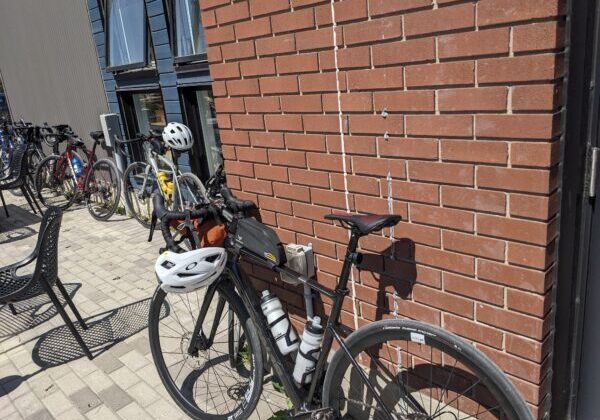
Arriving at T1, there were a few bikes still racked in the Iron 113 section (and hence some swimmers were still behind me). Unlike the Ironman Triathlon where I was just happy to be there, this time I hurried through my transition and quickly wheeled my bike out to the course, which was a 5 km stretch of road (closed to motor vehicles) on which I would do nine round-trip loops, for a total of 90 km.
There is a cardinal rule in endurance sports that one does not try new things on race day, be it clothing, nutrition, or race strategy. I decided to break said rule on this day by attempting to bike 90 km non-stop with no breaks for the first time.

The first kilometer or so was pretty lonely, though I quickly started encountering other participants coming the opposite way, as well as catching up to others ahead of me. About 20 km into my ride the sprint triathletes (750 m swim, 20 km bike, 5 km run) started entering the bike course, followed shortly after by the Olympic distance triathletes (1.5 km swim, 40 km bike, 10 km run). The bike course started getting crowded, but everyone was pretty good at staying to the right and letting faster cyclists (like me) pass on the left.
In the final third of my bike ride the “Try a Tri” triathletes (200 m swim, 10 km bike, 2.5 km run) entered the bike course, including a number of children. The younger participants were less familiar with the rules of the road, and I yelled “Passing on your left!” a few times in order to pass safely.
Nearing the end of the bike course I was averaging 30 km/h since the beginning of the ride, which I had never done before for such a long distance, breaking the aforementioned cardinal rule once again. I ultimately reached my goal of completing the bike course without putting a foot on the ground until the end.
The bike portion would turn out to be the most fun part of the triathlon, as it was the only part where I overlapped with so many participants from other race distances, as they began their swim after I exited the water and completed their run while I was still biking. I would encounter the Olympic distance triathletes again later while running.
Run
Entering the running track and racking my bike at T2 (which was the same spot as T1), I put on my running shoes, strapped on my hydration belt, put on my cap and headed out for the 21.1 km half-marathon, on a slightly more than 2.5 km stretch of road on which I would run four round-trip loops. A long-distance run consisting of multiple loops of a short course is psychologically worse than running a longer course for fewer loops in my opinion, so I knew this would be a mental battle.
I started the run alongside Iron 113 and Olympic distance triathletes (on such a short run course one is never far from other participants going in both directions). While my legs were a little bit sore coming off the bike, the beginning of the run felt good and I quickly settled into my race pace. The first loop came and went and gave me a firm idea of how much distance still lay ahead, though I forced myself to concentrate solely on completing the loop. Along the way I passed through a residential area with homeowners manning aid stations outside their houses and spraying hoses to help cool us down. By the second loop I was maintaining a reasonably consistent pace and coming into the third one I began thinking about the finish line.

By the fourth and final loop it was almost exclusively Iron 113 triathletes still on the run course, with the occasional Olympic distancer. Maintaining my pace throughout the loop, I entered the stadium running track and crossed the finish line to complete my first Iron 113 Triathlon.
Results
- 1.9 km swim: 39 min 33 s (2 min 04 s/100 m);
- T1: 9 min 47 s;
- 90 km bike: 3 h 01 min 11 s (29.8 km/h);
- T2: 7 min 34 s;
- 21.1 km run: 2 h 13 min 12 s (6 min 18 s/km);
- Total: 6 h 11 min 17 s.
My swim time flummoxed me the most, as I have never swum at such a fast pace before, let alone after losing time doggy paddling and resting on the kayak. My T1 time was similar to the Ironman Triathlon, which is not bad since there was no volunteer helping me remove my wetsuit this time. The bike went well, as I held a faster pace over a longer distance than ever before, and did so without stopping to rest. T2 went a lot faster than at the Ironman, since it was not raining and I did not have to change all my clothes this time. Lastly, the half-marathon went well, though (like at Ironman) my expectations were vague given uncertainty over how I would feel after the bike. My total time comfortably eclipsed my 6 h 30 min goal.
Lessons learned
Respect the course distance
After the Ironman Triathlon on August 2 I became complacent in my swimming abilities, thinking I could get away with only a couple of pool swims before September 5 in order to focus on biking and running. On Iron 113 race day the swim course wasted no time punishing my complacency, and despite my better than expected swim time I came away with an important lesson on not underestimating the challenge of a long-course triathlon.
The value of a fun-oriented event
With 17 Somersault races happening at once, it was cool to be part of such a large, fun-first event geared towards beginners and veterans alike. Many participants were doing their first triathlon, and others (like me) were doing a triathlon of a given distance for the first time. Stakes were low, the atmosphere was relaxed, and race rules were forgiving (such as the ability if needed to end the swim early and still continue on to the bike).
Contrast this with the more corporate and competitive Ironman Triathlon, geared towards athletes who spend months or even years preparing, along with loads of money, and who travel from around the world to participate, with world championship qualification at stake for some. While setting this can be attractive in its own right, I also appreciate the laid-back, “come be part of the community” feel of Somersault.
What’s next
For the first time in a while, I do not have a planned sports event for the next few months. Stay tuned to this space to see what 2027 holds!

James Lin
James is the son of INZ founder Charles. He has a PhD in economics from the University of Alberta, and completed the Ottawa Ironman Triathlon on August 2, 2026.